
Artwork Research & Documentation
Untitled Florida Landscape
- RESEARCH
- ANALYSIS
- ILLUSTRATION
- DOCUMENTATION
An attribution question became a structured research record designed to answer a more useful set of questions: What is physically known about the work? What evidence supports the possible attribution? What remains unresolved? What does the market evidence actually support? And what should the owner do next?
The resulting record documented the painting's construction, support, signature, provenance, condition, comparable sales, value scenarios, research gaps, and next steps—while keeping established facts clearly separated from hypotheses and unresolved questions.
A sanitized example of a real Artwork Research Record prepared for an owner. Not an appraisal, authentication, certificate of authenticity, or USPAP valuation.
The question wasn't just “what is it worth?”
Market value was only one part of the problem. Answering it honestly meant working through the object itself first — what it is, what supports the attribution, what doesn't, and what evidence would change the answer.
PHYSICAL EXAMINATION
Medium, support, construction, board edge, frame, markings, dimensions and visible condition.
ATTRIBUTION RESEARCH
Signature construction compared against documented examples, including letter structure, spacing, placement, application and recurring characteristics.
PROVENANCE
Existing ownership evidence identified, missing history documented, and specific evidence worth recovering defined.
CONDITION & PRESERVATION
Potential moisture exposure and deterioration identified from photographs, with explicit instructions for what not to clean, alter or discard before specialist examination.
MARKET EVIDENCE
Completed-sale comparables distinguished from asking prices, with differences in attribution, condition, size, provenance and selling venue documented.
DECISION GUIDANCE
A sequenced plan for photography, measurement, provenance collection, specialist review, additional comparable research and eventual sale/retention decisions.
Every finding traces to a source.
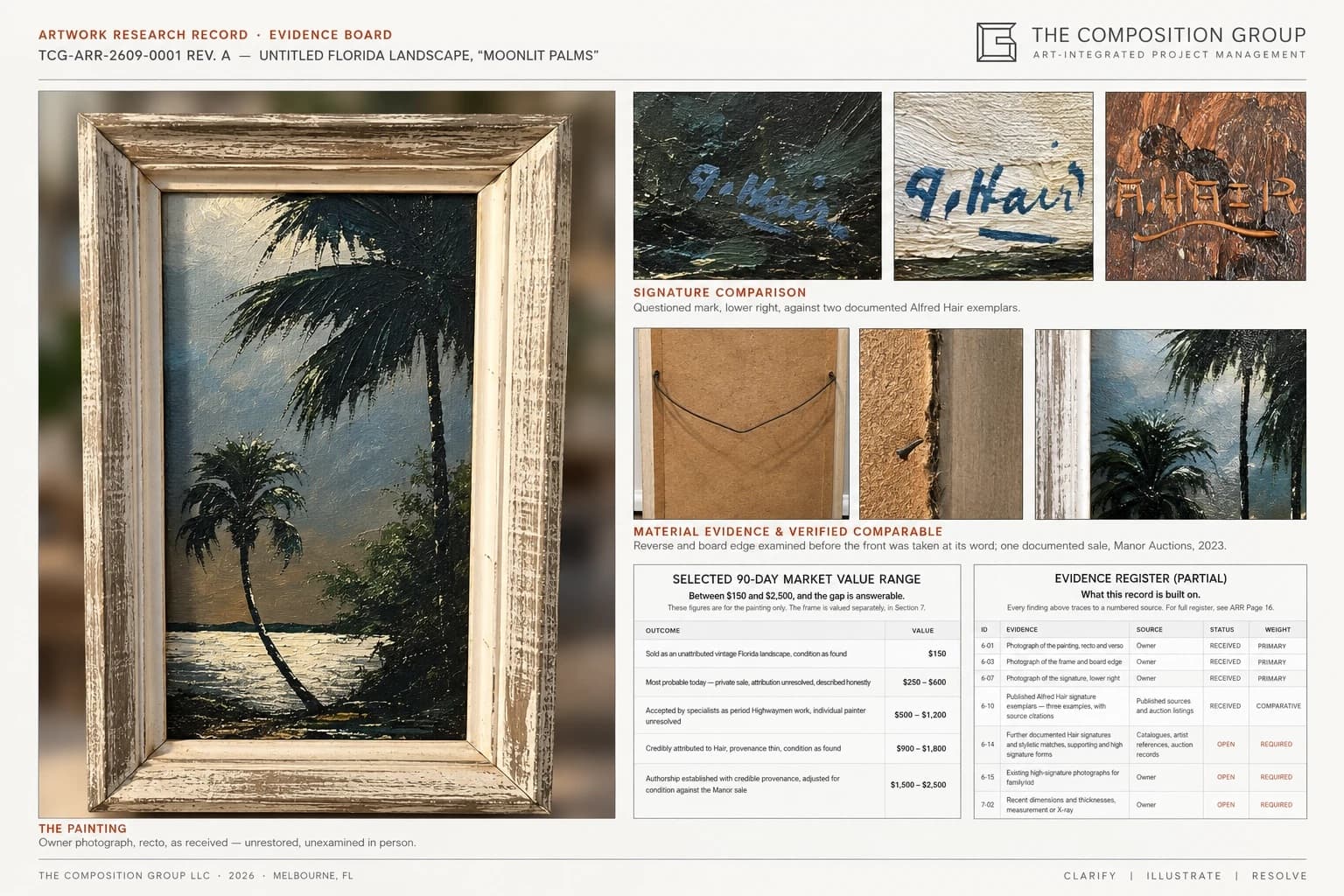
The painting, examined front and back; the questioned signature set against documented exemplars; the market modeled across scenarios instead of reduced to one number; and the register that ties every finding above to a numbered piece of evidence.
Seven findings established. Eight questions open.
ESTABLISHED
- Hand-painted oil rather than a print or reproduction
- Thick knife and brush texture
- Soft fiberboard visually consistent with Upson-type board
- Materials and mounting showing genuine age
- Subject and handling compatible with the relevant Florida painting tradition
- Questioned signature showing seven structural points of correspondence with documented Alfred Hair block-capital examples
- No stamp, label, inscription or documented provenance on the reverse
STILL OPEN
- Authorship
- Whether the signature is original to the painting
- Precise age
- Ownership history
- Complete physical dimensions
- In-person condition findings
- Additional verified comparable sales
- Specialist attribution
“Bears a signature consistent with documented Alfred Hair examples; authorship not authenticated.”
What research like this actually delivers.
Not “we think it's worth $X.” An uncertain object turned into an organized research problem, with documented evidence and defined next actions.
MATERIAL IDENTIFICATION
Research into what the artwork was physically made on and why that support matters to its historical context.
SIGNATURE FORENSICS
Structural comparison against documented signatures rather than assuming a matching name establishes authorship.
EVIDENCE GAPS
A formal register showing what evidence exists, what is missing, how much weight each item carries, and what would materially change the conclusion.
PRESERVATION GUIDANCE
Specific warnings against cleaning, restoration or replacing potentially evidentiary materials before the work is properly examined.
SELLER PROTECTION
Guidance for separating independent attribution from purchase offers, documenting possession and condition, avoiding artificial urgency, and describing uncertainty accurately.
RESOLUTION PATH
Specific photographs, measurements, provenance information, specialists, technical examination and comparable-sale research needed to move the question forward.
Between $150 and $2,500 — and the gap is answerable.
The research didn't assign one unsupported number. It modeled value across the different evidentiary scenarios the record actually supports — from an unattributed vintage Florida landscape, through progressively stronger attribution scenarios, to authorship established with credible provenance. One verified comparable sale anchors the low end of that range; the rest moves only as more evidence is confirmed.
Full evidence board shown above; the market matrix and evidence register are the lower-right panels.
ASKING PRICE ≠ HAMMER PRICE ≠ BUYER COST ≠ SELLER PROCEEDS
One completed sale can be described four different ways. The record verifies which figure is which before it goes in a table.
17-page Artwork Research Record
Research that shows what is known, what isn't, and what evidence would resolve the difference.